


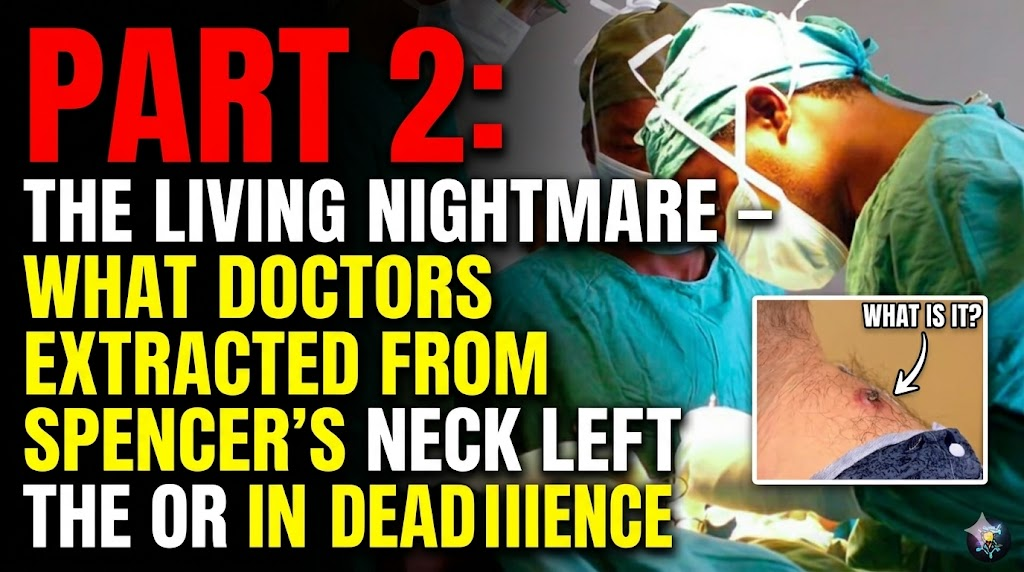
The Horrifying Truth Beneath the Skin: Inside the Operating Room
The operating room descended into an eerie, suffocating silence. The only sounds echoing off the sterile white walls were the steady, rhythmic beeps of the heart monitor and the muffled, sharp breaths of the medical staff behind their surgical masks. Spencer, mildly sedated but awake under local anesthesia, could feel the intense pressure of the surgical tools, though the pain had been temporarily numbed.
When the lead surgeon carefully made a small, precise incision into the angrily swollen, purple lump on the back of Spencer’s neck, the medical team had braced themselves for the usual. They expected to extract a deeply embedded, stubborn splinter, drain a severe bacterial abscess, or perhaps remove the venom sac of an exotic arachnid.
But as the scalpel parted the inflamed tissue, the doctor froze. What they saw underneath the skin wasn’t a pool of infection, and it certainly wasn’t sitting still.
It was moving. And it was breathing.
A Giant Parasite Hidden in Plain Sight
The moment the medical forceps gently probed the core of the mass to get a better look, something pale, grey, and covered in microscopic ridges began to violently squirm and contract to avoid the light. Even the most seasoned, iron-nerved surgeon in the room had to take a physical step back, a cold sweat breaking out on his forehead. This wasn’t a severe bug bite or an allergic reaction. It was a nest.
Buried deep within the dense muscle fibers of the young father’s neck was a massive, fully active botfly larva. However, its size far exceeded anything the medical staff had ever encountered in standard medical journals. The creature had been quietly living as a parasite, feeding off Spencer’s blood and nutrients, using a tiny breathing hole on the surface of his skin to survive. It had been burrowing deeper into his neck tissue for weeks, growing larger and stronger every single day without him ever realizing the true horror of his condition.
But what truly made the medical team’s blood run cold wasn’t just the grotesque, alien-like sight of the parasite; it was the incredibly dangerous, near-fatal location it had chosen to call home.
The Thin Line Between Life and Permanent Paralysis
The atmosphere in the room shifted from routine focus to extreme, high-stakes panic. The surgeon had to extract the creature with agonizingly slow, calculated, and precise movements. A single slip of the hand, or a sudden, violent rupture of the parasite’s body under the pressure of the forceps, could have triggered a massive release of toxins, sending Spencer into immediate anaphylactic shock.
But the physical location was the true nightmare:
The Kill Zone: The lump was resting mere millimeters away from Spencer’s cervical spinal nerves—the delicate superhighway of nerves that controlled his upper body.
The Cost of Delay: Had Spencer ignored the escalating, throbbing pain, taken painkillers, and delayed his hospital visit by just 48 more hours, the larva’s relentless burrowing would have inevitably breached his spinal cord lining.
The Grim Prognosis: If that breach had occurred, Spencer would have faced the very real, terrifying risk of permanent, irreversible paralysis from the neck down, or a highly lethal case of bacterial meningitis that could have ended his life within days.
A Chilling Aftermath and a Warning for Us All
After two incredibly tense and agonizing hours of delicate surgical maneuvering, the parasite was finally pulled free, and the surgery was declared a complete success.
Later that afternoon, when Spencer woke up from the heavy sedatives and was shown the thumb-sized, spiky, grey creature floating in a glass jar of formaldehyde, the color entirely drained from his face. He felt violently ill. Suddenly, the puzzle pieces clicked together. He vividly recalled a deep-woods camping trip with his family nearly a month prior, where a strange, oversized fly had briefly landed on the back of his neck while he was chopping firewood. A fleeting, seemingly harmless five-second moment had almost cost a father his mobility, his future, and his life.
Spencer’s horrifying ordeal serves as a chilling, real-life reminder for all of us: Never ignore abnormal, lingering changes in your body. A tiny swelling, an itchy bump, or a stubborn “pimple” that seems entirely harmless can sometimes be the creeping start of an absolute nightmare.
A Critical Note from Medical Professionals: If you ever develop a “bug bite” or lump that doesn’t heal after a few days, especially if it is accompanied by deep, throbbing pain, a hard inner core, a small opening at the center, or a bizarre “wiggling” or “fluttering” sensation underneath the skin—do not attempt to pop or squeeze it. Seek immediate medical attention at an emergency room. Sometimes, delaying just one more day can change your life forever!